Let me begin with a confession: until fairly recently, I was scared of agentic AI. Not scared in the cinematic, robots-taking-over sense; scared in the far more mundane sense of a man who has read the word "orchestration layer" one too many times and quietly decided this party was not for him. I had fiddled with OpenClaw once, and the setup and maintenance demanded the devotion of a temple priest while paying out roughly nothing, so I retreated to my chatbots and told myself I was happy. And I was, the way you are happy with a scooter after a test drive in a car that refused to start.
What finally dragged me in was not a keynote or a whitepaper but a YouTube tutorial; some chap explained Claude Projects with such disarming clarity that I sat up in bed and built one. First a project to run my blog, then one to manage my VPS, and when neither exploded, I smuggled the habit into office; product launches, competitive analysis, the usual corporate theatre, now running on rails. Then skills arrived and quietly rearranged my week. Entire chunks of work got automated, hours were freed, and instead of doing the respectable thing and refilling those hours with more work, I spent them learning. Tina Huang, Nate Herk, Ruben, EverydayAI; a rotating panchayat of internet mentors who kept me going and have no idea I exist.
Then I stumbled upon Hermes, and something clicked that had never clicked before. The simplicity, the aesthetics; I was hooked within the hour. Hermes led me to discover OpenRouter, and the rabbit hole began a journey to the center of the earth. Until then I had been faithfully oscillating between OpenAI, Claude, and Gemini like a devotee doing rounds of three temples - and feeling smartly coy about it; OpenRouter handed me the keys to ALL of them and then some. Playing with GLM, Qwen, Deepseek, Hy3, Kimi and the likes i had never been exposed to hitherto, and discovering they delivered nearly the same output at a fraction of the cost (yes, you've heard it alot because its true), did to my curiosity what a Big Billion Day sale does to the average Indian household budget.
An old itch
Now, some context. I have nursed a long-standing ambition to own my very own personal cloud; to pack my digital life and move out of big tech's low-rent but highly exploitative accommodations. Every previous attempt died at the same checkpoint. The maintaining, the securing, the monitoring; it was a second job with no salary, and so the grand summit of my self-hosting career had been a personal drive and a couple of humble apps, Nextcloud and Immich, blinking at me from a server that could clearly do so more more.
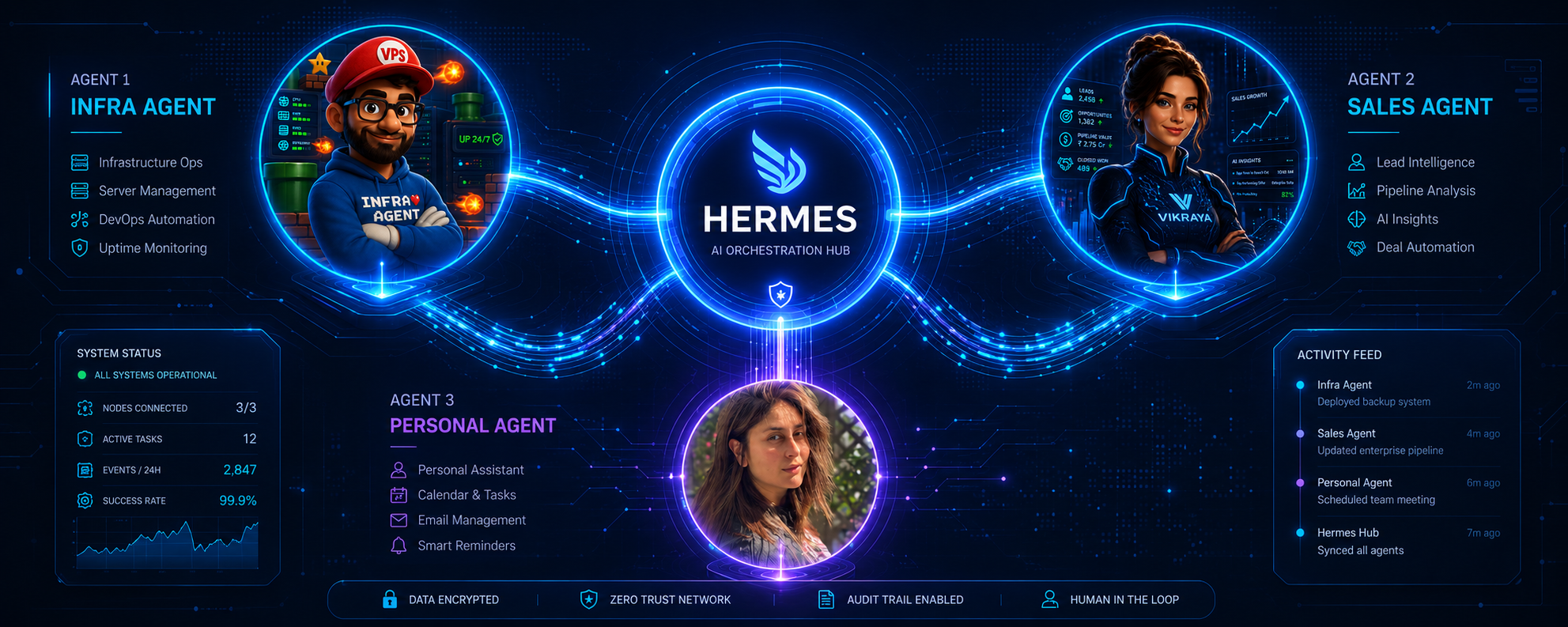
Armed with Hermes, I decided the itch would finally be scratched. Project one: an agent to run the VPS for me. I extracted a full download of my server setup from Kodee, Hostinger's own agent (a genuinely brilliant one, credit where due), and handed the entire dossier to my new agent, whom I had named, after what I can only describe as a lack of lightning storm of creativity - "itguy."
My ambitions were modest. I wanted itguy to deploy websites; nothing more. But I am also not in the habit of handing root access to anything (especially my VPS) without verified paperwork, so I sat with Claude and drafted a proper scope; what it could do, the guardrails it would operate within, my expectations, and the no-go zones. I fed it the scope and the server details, and we began. I was still building the websites in Claude at this point, ferrying files over to itguy like a courier between two offices of the same company.
Two and a half hours of back-and-forth later, the workflow was set. I could now go from scratch to hosted website in 5 minutes. Let me repeat that in plainer terms: I typed a message, uploaded some files, and five minutes later there was a functioning website on the public internet, hosted on my own VPS - all courtesy itguy. The next morning, I ran a second test from the back seat of a cab on the way to work; I uploaded a content doc, gave it a reference for the look I was going for, and then just told it to get me the finishedd site. I had 6:1 odds that itguy would struggle - no way he can do this while I'm away from root access of the VPS. Five minutes later - live, functional site. I sat there ensconced in Bangalore traffic (where, let's be honest, people of this city do most of the living anyway) staring at my phone in amazement. The spell was cast - on me and hard!
Escalation, as a lifestyle
Success made me greedy. Websites were no longer enough; I now wanted itguy to run the whole estate. Health reports, new domains, Docker containers, fresh app deployments, everything on the VPS through instructions I route through Telegram. This triggered another long night; figuring out APIs, monitoring model usage, adding credits to OpenRouter, writing scripts to prevent root access, setting new rules, shopping between models to save tokens. It was a struggle, and I will not romanticise it. But finally at 2:30 in the night, itguy assumed full autonomous control of my VPS. I had, in effect, hired a systems-administrator-cum-night-watchman who never sleeps, never sulks, and never asks for a Diwali bonus.
That is when the real fun began. Running on GLM 5.2, itguy no longer needed me designing sites or wrestling DNS records. I described what I wanted and named the domain; five minutes later, it existed. If you would rather have proof than my word: agnishwarbanerjee.info . Built entirely on a single prompt instruction, while I was learning about hosting models locally.
The next requirement announced itself. If one agent could run my server, another could technically run parts of my life; the reminders, the errands, quick searches, updating tasks - the assorted shenanigans of functioning adulthood. One more night with itguy, wrapping up at the comparatively respectable hour of 1:00 AM, and Nora arrived; my beautiful, fully autonomous, loyal, personal agent, operating my life on my behalf while I supervise from a safe distance.
Coincidentally, Fable 5 was made available around this time, and I put it to work drafting security, privacy, and guardrail protocols for every Hermes agent I had built, applied across the lot. Out of abundant caution I verified the proposals against ChatGPT and two network-and-security friends at work; the verdicts came in between 8.5 and 9.5 out of 10 on completeness, accuracy, and effectiveness. When your paranoia scores a distinction, you sleep easier. Or you would, if you were sleeping at all.
Because on the third night, sleep eluded me, so I got up and built the thing I had been circling around for weeks: a sales CRO agent. This one, named Vikraya, spawned three sub-agents for three distinct sales motions. The first audits third-party sales processes and, unlike every consultant I have ever paid, does not stop at recommendations; it carries out the actual fixes and then monitors performance for two weeks before it is allowed to declare victory. The second prospects, qualifies leads, analyses calls for sentiment, and prepares proposals, all autonomously. The third sets up sales processes and builds teams for early-stage startups. By now the whole affair had stopped feeling like software and started feeling like sorcery, and I was the wizard; untrained, unwashed, and up past bedtime on a weeknight.
The bit nobody tells you
Here is what I actually think, and it is not what most people say: these agents saved me enormous amounts of time, but my total working hours have gone up. Not down. Up. Because when the cost of building something collapses to a prompt and five minutes, you stop rationing your ambitions. I built more websites for friends. I even built a personal wealth tracking app. My plans queue is now longer than it has ever been; the only reason I am not building anything new right now is that my hands are full, not my head.
So yes, Agentic AI is an exponential jump in the way we work and live and in testing society. But AI has a large (and growing) sect of skeptics, haters and no-gooders as well.
My position on this is equally plain. I will not blame AI. I blame its creators for the mess and the corruption they are indulging in and governments for the blind eye they turn as their pockets get greased. The technology by itself, is a tool; it does what its owner makes it do. AI never sat down one morning and decided to build data centres, destroy clean water supplies, traumatise people, or "act agentic." Every one of those outcomes flows from its masters, and they deserve the full weight of the blame for doing precious little to keep it on a correct ethical and moral compass. The knife and the hand holding it are not the same thing, and currently this group is trying to indict the knife for the crimes of the hand. Something needs to be done about this - perhaps a new agent?
That said, this technology is here to stay, and it is astonishing. It took an average middle-aged guy like me and turned him into a confident builder of online products and services; nothing in my life has done that before. And the ecosystem, the frameworks, the influencers, the tutorials, makes starting almost embarrassingly easy. The real entry fee is that one sleepless night; fiddling, breaking things, learning, getting slightly better, then getting confident.
Mine cost three. What will yours cost? See ya on the other side.