The number I cared about most was hiding behind yet another dashboard. So I moved it to a place I cannot look away from.
Why
There is a particular kind of number every grown-up eventually learns to avoid. The weighing scale the week after Diwali or New Year. The screen-time report on a Sunday night and so on. For most of this year, mine was what my AI agents were costing me, which is an odd thing to be squeamish about when you consider that I am the one who set them loose in the first place.
Not that the number was a secret though. Every token in, every token out, every fraction of a dollar was faithfully logged in multiple places across several accounts. The records existed, dutifully but much in the same way the way that old, printed photos exist in drawers and cupboards nobody opens. The problem was instant, consolidated access. To find out what I had spent today, or in this session, or since yesterday, I had to open yet another dashboard, click through several screens apparently designed by someone who gets paid on per click model, and then, having finally arrived, discover it still could not tell me the thing I actually wanted - the current session token and dollar costs, split by agent. So I would count. Figuratively, by hand. Tokens in, tokens out, multiply, add, squint, repeat (in 2026, I should add, with two perfectly capable AI agents idling in the next window, presumably amused).
The hinge came on an otherwise unremarkable evening, halfway through one of these little arithmetic rituals, when it occurred to me that I was doing manual bookkeeping on behalf of software that writes code and when I have multiple agents as friends. That was the end of it. No more counting by hand, no more opening things I never otherwise open. If the number mattered this much, it deserved to live somewhere I could not ignore it.
So I did the rational thing in 2026, and called upon my agents to help me built a widget.
What it is
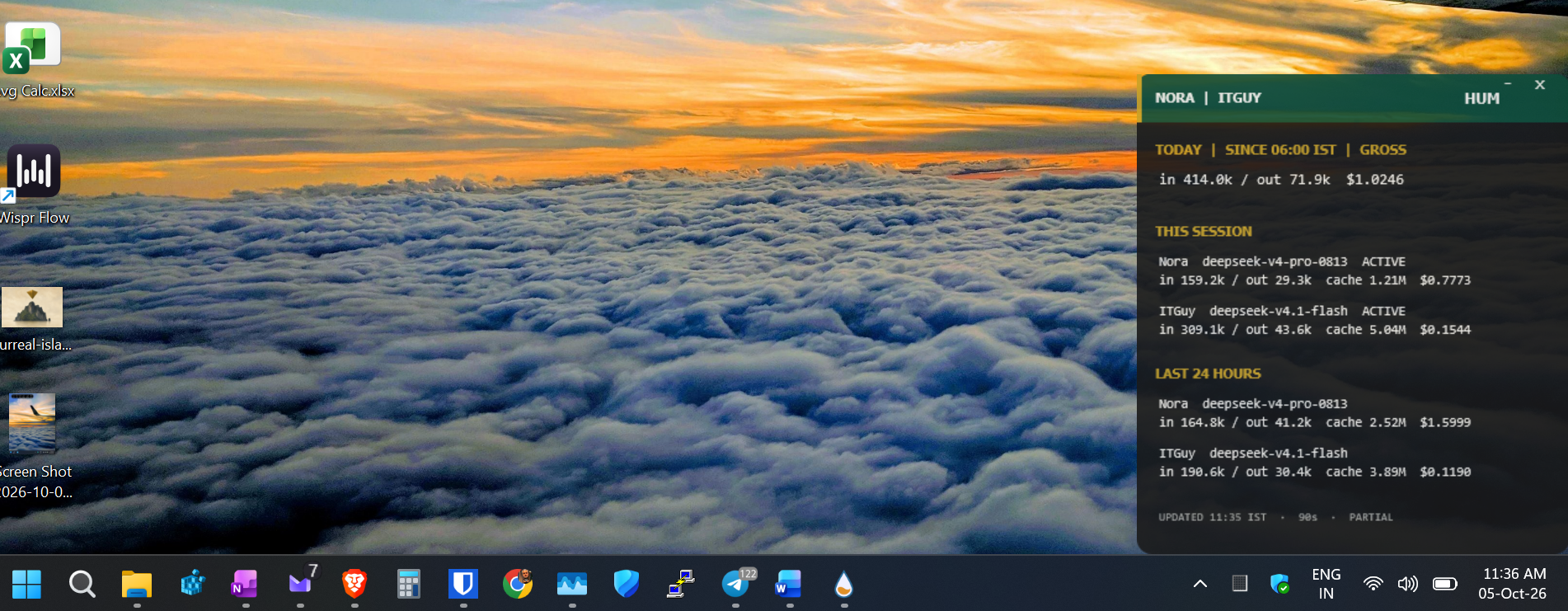
I call it HUM - Hermes Usage Meter. It is a small dark card thats ever present on my desktop, present but quiet, rather like a well-trained butler who has also, inconveniently, has been put in charge of the accounts. It shows what both my agents have cost: what has gone in, what has come out, and the dollar figure, for today, for the current session, and for the last 24 hours. Every minute or so it updates itself, without being asked, and then goes back to minding its own business.
It is not a dashboard. There are no charts to interpret, no history to browse, no filters to fiddle with on a slow afternoon. It is a fuel gauge, and like any fuel gauge, its entire value lies in living in the corner of the eye rather than three menus deep.
How we built it, together
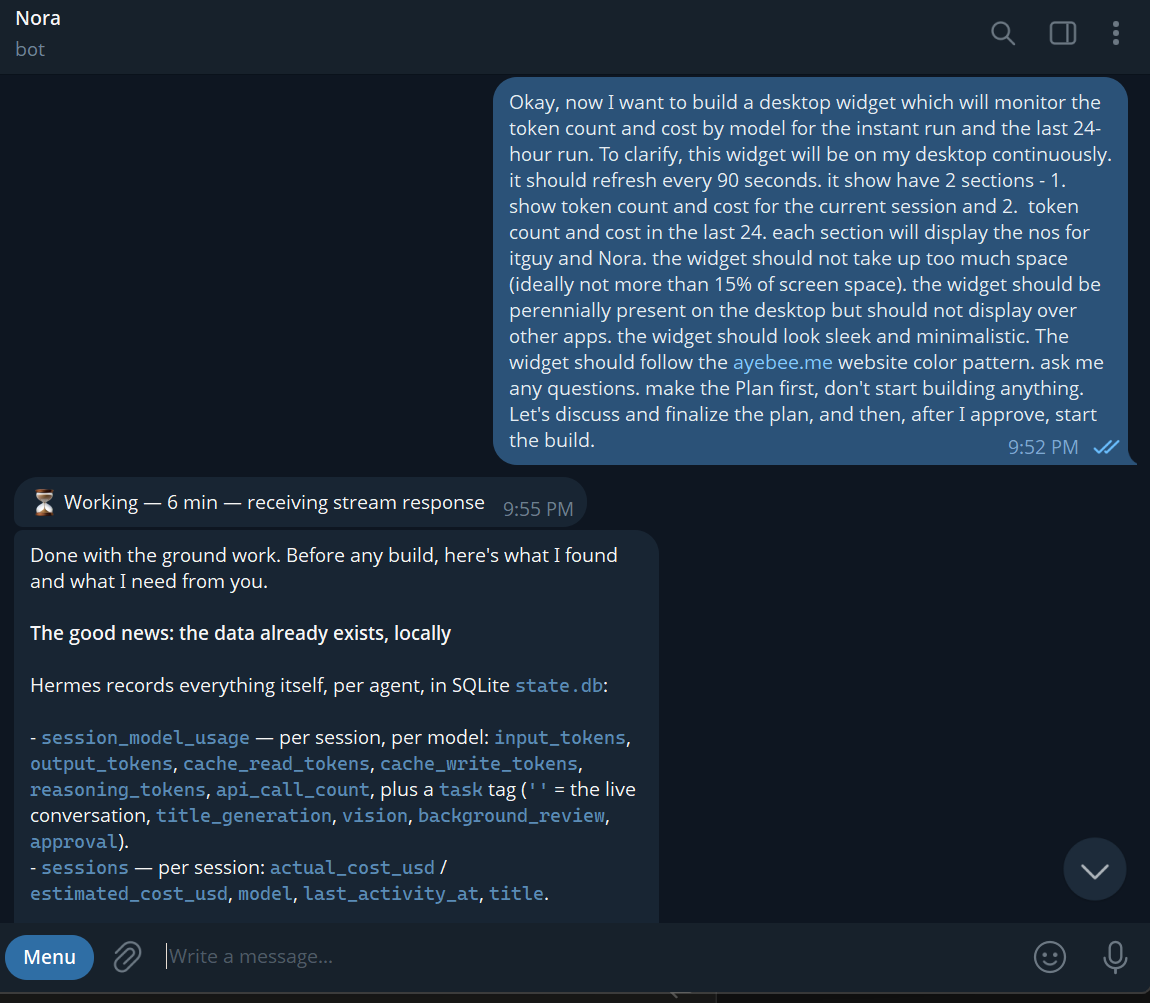
This was not a solo act, and I would be overstating my engineering credentials (considerably) if I pretended otherwise. Three of us split the work, deliberately.
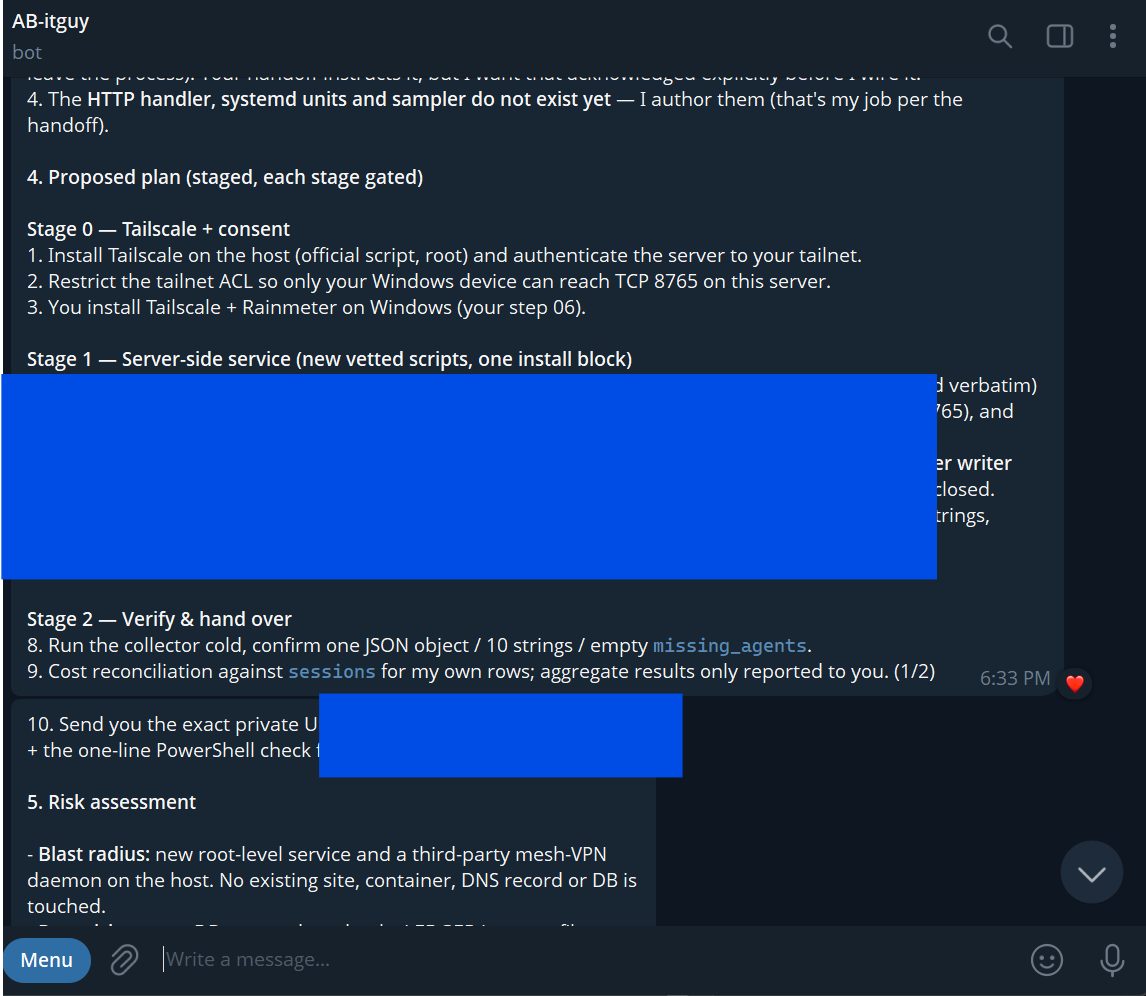
I owned the what and the when: what the card should show, how it should look, and the final, faintly ceremonial act of installing it and watching it come alive. Nora, my ever loving personal assistant, did the thinking work; she wrote the pipe that turns a heap of raw records into a single clean answer, and the design that puts that answer on screen. ITGuy, my ever faithful server and infrastructure agent and a sort of sysadmin-cum-bouncer, stood between the data and my desk and kept it private; he decides what is allowed out of the building and, more to the point, what is not (I call this security; he, I suspect, calls it an ordinary Tuesday). Each of us held a piece; none of us held the whole.
The order mattered, and I think it says something about how I work. The look came first: a mockup, agreed before a single wire was connected, so that the code followed the intent instead of inventing one. Then the pipe. Then the honest bit, a reconciliation step that checks the numbers against each other rather than trusting the first answer that comes back looking confident. Then, finally, the screen.
Underneath all of it sat a boundary I was quite stubborn about. The two agents' records were kept apart on purpose, and ITGuy enforced it with the cheerful inflexibility of a bank clerk five minutes before lunch. Each shares only the smallest pre-drawn summary with the widget; nothing raw, nothing private, nothing that would let one agent read over the other's shoulder.
What I learned
The sharpest lessons, predictably, came from the human and fallible parts, not the clever ones.
The first was typography. A small decorative separator got rendered as garbage on the desktop in production. Due to a mismatch in fonting instructions, Windows could not see this. The first fix was clever, in the proud jugaad tradition, and therefore fragile; the real fix was to remove the ambiguity altogether and use something no font could misread. Nora to the rescue. I sent her a screenshot and in less than 2 minutes she sent me a patch to deploy. Situation analysed, problem identified, remediation decided, prepared and provided - all in just over 90 seconds.
The second was more humbling. What should have been a routine re-deploy of the patch file, quietly reverted a setting I had configured by hand, and the widget went dark. itguy confirmed the data was fine, the pipe was fine and the fault lived in a handover that forgot to say four words: keep this endpoint line the same. A tiny gap that slipped through all 3 of us. But again, situation analysed, problem identified, remediation decided, prepared and provided - all in less than 90 seconds this time.
One small habit saved us more than once: testing before trusting. It caught a leak and a double-count before either reached a live screen, which is the only kind of bug I genuinely enjoy finding.
Which brings me to what I actually think, and it is not quite what the hyper and excitable corner of the internet says. AI Agents may not be bringing abundance shortly, but it opens up possibilities in almost the same way the internet did 30 years ago. In fact I daresay, it opens more possibilities - joyful, useful and frightening, all at once.
How it helps
I will not pretend the widget has made me thrifty (it has not; I am simply better informed about my extravagance). What it has done is quieter. The cost now lives in the corner of my eye instead of across three drawers, a mild and steady pressure toward noticing, rather than a spreadsheet I would have abandoned by the second week.
It scales without fuss; another agent is just another row. But the real return is simpler than any of that. It is one fewer thing to hold in my head. For months I carried a running tally I never quite trusted, the way you keep a vague mental note of what is left in the account before payday.
Now the meter watches, so I do not have to. Which leaves the slightly awkward question of what, exactly, I am going to worry about next.